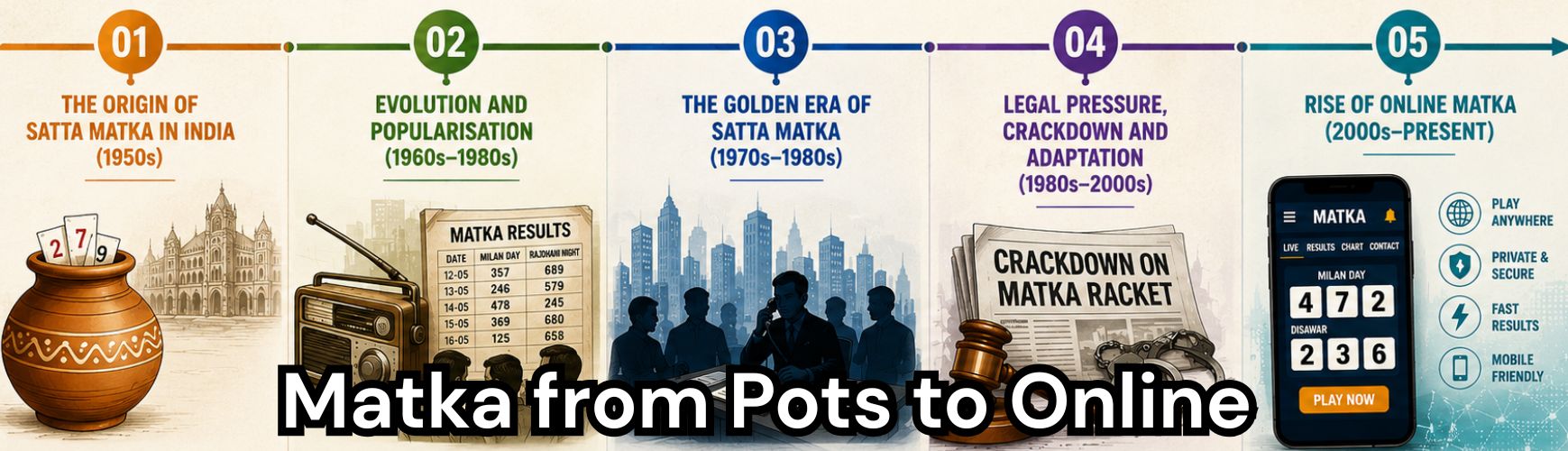

Satta Matka is one of the most recognized forms of number-based gambling in India. What started as a small betting activity connected to cotton trading in the 1950s eventually transformed into a massive underground betting network across the country. Over the decades, Satta Matka evolved from paper slips and earthen pots to mobile apps, websites, and online payment systems.
Even though gambling laws in India restrict or prohibit most forms of betting, Matka has continued to survive due to its deep cultural roots, simplicity, and accessibility. Today, the rise of smartphones and digital technology has completely changed how Matka operates, giving birth to what is now widely known as Online Matka.
We explores the complete history of Satta Matka, including its origins, rise in popularity, major personalities, legal challenges, and transition into the digital world.
The term “Satta” means betting or gambling, while “Matka” refers to an earthen pot traditionally used to draw numbers randomly. In its classic format, players choose numbers and place bets on possible outcomes. Winners receive payouts based on odds and combinations.
Originally, the game was associated with betting on cotton exchange numbers. Later, it evolved into a lottery-style number game where random slips were drawn from a matka (pot).
Over time, multiple formats and betting styles emerged, including:
Single
Jodi
Patti
Sangam
Half Sangam
Triple Patti
These variations increased the game’s popularity among gamblers across India.
The origins of Satta Matka date back to the 1950s in Mumbai, then known as Bombay. During this period, traders and workers involved in the cotton industry began betting on the opening and closing rates of cotton traded on the New York Cotton Exchange.
The rates were transmitted daily to the Bombay Cotton Exchange, and bettors started wagering on the numbers associated with these rates. This early version of the game became known as “Ankada Jugar,” meaning figures gambling.
The betting process was simple:
Players selected numbers between 0 and 9.
Bets were placed through local operators.
The winning numbers were based on cotton market figures.
Winners received cash payouts depending on odds.
At this stage, the game was relatively informal and limited to certain business and labor communities in Bombay.
In 1961, the New York Cotton Exchange stopped transmitting cotton rates to the Bombay market. This created uncertainty for local gambling operators who depended on those numbers for betting results.
To continue the business, operators developed a new random number drawing method.
Small slips containing numbers were placed into an earthen pot called a “Matka.” One slip was then drawn publicly to determine the winning number. This process introduced complete randomness and gave birth to the modern Matka system.
The use of the earthen pot became so iconic that the game itself started being called “Matka.”
Kalyanji Bhagat played a major role in shaping the Matka gambling industry. Originally a farmer from Kutch, Gujarat, he migrated to Mumbai in search of better opportunities.
In 1962, he launched the famous “Kalyan Matka” operation, which quickly became popular due to organized systems and higher payouts.
Kalyanji introduced:
Structured betting timings
Fixed payout systems
Organized agent networks
More transparent result announcements
His Matka network expanded rapidly across Mumbai and neighboring states. Bettors trusted the Kalyan Matka because of its consistency and reliability.
Soon, “Kalyan” became one of the biggest names in the Matka industry.
Ratan Khatri is widely regarded as the most influential personality in the history of Satta Matka.
In 1964, he launched the famous “Worli Matka” in Mumbai and introduced a new and more organized format of betting.
Unlike earlier systems linked to cotton rates, Ratan Khatri focused entirely on random number draws.
His format involved:
Playing cards
Number slips
Public draws
Fixed rules and timings
Fairness demonstrations
Ratan Khatri gained immense popularity because he openly conducted draws in front of crowds, increasing public trust in the system.
He became known as the “Matka King” and built a massive gambling empire during the 1970s and 1980s.
During the 1970s and 1980s, Satta Matka reached the peak of its popularity.
Several factors contributed to its rapid growth:
Players could start betting with very small amounts, making the game accessible to people from all economic backgrounds.
Matka offered attractive payouts compared to traditional lotteries.
A large network of bookies, agents, and sub-agents expanded operations into cities and small towns.
Frequent draw timings kept players continuously engaged.
Although Mumbai remained the center of Matka operations, the game quickly spread to:
Maharashtra
Gujarat
Rajasthan
Delhi
Madhya Pradesh
Uttar Pradesh
South India
Different regions introduced local versions and unique betting methods.
Some famous Matka markets included:
Kalyan
Worli
Main Mumbai
Milan Day
Rajdhani
Time Bazar
These names became extremely popular among gamblers.
Before the digital era, the entire Matka system operated manually.
Players selected their preferred numbers or combinations.
Local agents collected bets using handwritten slips.
Operators maintained ledgers and betting records manually.
Winning numbers were announced through public draws.
Agents distributed winnings to successful players.
This offline structure relied heavily on trust, secrecy, and personal networks.
Agents were the backbone of traditional Matka operations.
Their responsibilities included:
Collecting bets
Maintaining customer records
Sharing results
Handling payouts
Recruiting new players
Bookies often operated from:
Tea stalls
Pan shops
Small offices
Local markets
The informal nature of the business made it difficult for authorities to control.
Gambling Laws in India
Satta Matka has long operated under legal restrictions in India.
Most gambling-related activities fall under the Public Gambling Act of 1867, which prohibits running or visiting gambling houses in many states.
As Matka grew in popularity, law enforcement agencies began targeting operators and networks.
During the 1980s and 1990s:
Several major operators were arrested
Police conducted regular raids
Betting centers were shut down
Financial investigations increased
Even famous Matka operators faced legal troubles.
However, despite crackdowns, the demand for Matka never disappeared completely.
To avoid legal pressure, operators continuously changed their methods.
Common strategies included:
Secret betting locations
Coded communication
Frequent relocation
Decentralized operations
Hidden ledgers
Matka gradually became an underground betting network operating outside public visibility.
The arrival of telephones and mobile communication dramatically changed the gambling industry.
Before the internet became mainstream, Matka operators started using:
Telephone betting
SMS result services
Pager communication
Recorded hotlines
Players no longer needed to visit betting centers physically.
This marked the beginning of the transition toward Online Matka.
The rise of the internet in India during the early 2000s completely transformed the traditional structure of Satta Matka. What once depended on physical betting centers, handwritten slips, and local agents gradually moved into the digital world. Faster internet connections, affordable smartphones, and the rapid expansion of mobile technology allowed Matka operators to reach players far beyond local neighborhoods and city markets.
In the traditional system, bettors had to visit agents personally to place bets and collect winnings. This process involved physical risk, travel, secrecy, and dependency on local operators. However, the digital revolution eliminated many of these barriers. Online platforms enabled players to participate from their homes using mobile phones or computers.
As internet usage increased across India during the late 2000s and early 2010s, many Matka operators launched dedicated Online Matka websites and mobile-friendly platforms. These websites provided users with several modern features, including:
Live Matka result updates
Online betting panels
Historical charts and records
Guessing tips and number analysis
Automated payout systems
Customer support services
Players no longer needed face-to-face interaction with local agents because most activities could now be managed digitally through websites and apps.
The popularity of smartphones and messaging applications accelerated the expansion of Online Matka across India. Operators began using multiple digital channels to engage with users and distribute results instantly.
Popular communication methods included:
WhatsApp betting groups
Telegram channels
SMS-based result alerts
Facebook communities
Social media pages
Private online forums
These platforms allowed operators to quickly share betting rates, daily numbers, jackpot information, and live results with thousands of users at the same time.
Telegram and WhatsApp became especially popular because they offered privacy, speed, and direct communication between operators and players.
One of the biggest reasons behind the growth of Online Matka was the introduction of digital payment systems in India. Earlier, most betting transactions were conducted in cash, which created operational challenges and security risks.
With the rise of online banking and mobile payments, transactions became much easier and faster.
This digital payment ecosystem simplified deposits and withdrawals for players and helped operators expand their businesses more efficiently.
Affordable Android smartphones and low-cost internet plans played a major role in expanding Online Matka into smaller cities, towns, and rural areas. Millions of new internet users gained access to betting websites and applications through mobile devices.
Unlike traditional Matka, which mainly operated in urban gambling hubs like Mumbai and Pune, online platforms removed geographical limitations. Players from different states could now participate remotely without visiting physical betting centers.
This technological shift significantly increased the reach and scale of the Matka industry.
Modern Online Matka systems are far more advanced than traditional betting networks. Many platforms now use automated technology to improve user experience and operational efficiency.
Common features of today’s Online Matka websites include:
Real-time result announcements
Automated betting systems
User dashboards and betting history
Referral and bonus programs
24/7 accessibility
Mobile notifications
Fast withdrawal systems
Some operators have also developed dedicated Android applications that allow users to place bets instantly and receive live updates directly on their smartphones.
Despite its digital growth, Online Matka continues to face serious legal and regulatory challenges in India. Gambling laws differ across states, and many forms of betting remain illegal under existing regulations.
The online environment has also introduced new risks such as:
Fraudulent betting websites
Fake payment platforms
Data privacy concerns
Cyber scams
Manipulated results
Authorities regularly monitor and block illegal gambling operations, but many platforms continue operating through changing domains, mobile apps, and encrypted communication channels.
The transition from offline gambling networks to digital betting platforms represents one of the biggest changes in the history of Online Matka. Traditional systems based on paper slips and local agents have largely been replaced by websites, apps, and automated technology.
Today, Online Matka operates as a fast-moving digital ecosystem that combines gambling culture with modern internet technology. Although the industry has changed dramatically over the years, the core concept of number-based betting remains the same, preserving the legacy of the original Matka system while adapting to the modern digital era.
Image***
Today’s Online Matka platforms are far more advanced and technology-driven compared to traditional Matka operations. Earlier, the entire betting process relied on physical agents, handwritten records, and manual result announcements. However, modern online systems have introduced digital tools and automated features that make betting faster, easier, and more accessible for users.
With the growth of smartphones, internet connectivity, and digital payment systems, Online Matka platforms now offer a complete virtual betting experience. Below are some of the most important features that define modern Online Matka websites and applications.
One of the biggest advantages of modern Online Matka platforms is mobile accessibility. Most users now access betting websites and apps directly from their smartphones without needing a desktop computer or physical betting center.
Modern Matka websites are designed to work smoothly on Android devices, tablets, and mobile browsers. Some operators also provide dedicated mobile applications for faster betting and real-time notifications.
Traditional Matka systems depended heavily on cash transactions handled by local agents. Modern Online Matka platforms have replaced this process with digital payment solutions, making transactions quicker and more convenient.
Digital payments simplify both deposits and withdrawals for users. Players no longer need to meet agents physically to transfer money or collect winnings.
Fast payment systems have also improved the overall user experience and allowed operators to manage transactions more efficiently.
In traditional Matka operations, players often had to wait for agents or local announcements to know the winning numbers. Modern Online Matka platforms now provide live result updates in real time.
Many websites and mobile apps also send instant notifications through SMS, WhatsApp, or Telegram channels whenever new results are declared.
This real-time engagement keeps users constantly connected to the platform and increases overall participation.
Technology has greatly reduced the manual work involved in Matka operations. Earlier, agents maintained handwritten ledgers and manually calculated winnings, which often resulted in mistakes or disputes.
Computerized systems improve speed, accuracy, and operational efficiency. Automated platforms also help operators handle large numbers of users simultaneously without maintaining physical records.
In many cases, users can view their betting history, account balance, and transaction details directly from their online dashboard.
Unlike traditional Matka centers that operated during fixed timings, Online Matka platforms are accessible 24 hours a day. Players can visit websites or apps anytime without location restrictions.
The internet has removed geographical limitations that once restricted Matka operations to local markets and urban gambling hubs.
Today, users from different parts of India can participate in Online Matka using only a smartphone and internet connection.
Several traditional Satta Matka markets successfully transitioned from offline betting networks to digital platforms during the rise of the internet era. These well-known Matka brands built strong reputations over decades, and their names continue to dominate many Online Matka websites and mobile applications today.
Some of the most popular Online Matka markets include Kalyan Matka, Main Mumbai, Rajdhani Night, Milan Day, Time Bazar, and Worli Matka.
Among these, Kalyan Matka and Worli Matka are considered the most iconic due to their historical importance and long-standing popularity in Mumbai’s gambling culture.
These markets continue to attract users because players are already familiar with their names, result formats, and betting systems. Many online platforms use these traditional market names to maintain trust and connect modern users with the legacy of classic Matka gambling. Even in the digital age, these brands remain deeply associated with the history and evolution of Online Matka in India.
The rapid spread of affordable smartphones and low-cost internet services has significantly accelerated the growth of Online Matka across India. Earlier, participation in Matka required physical contact with local agents or access to specific gambling hubs. However, smartphones have completely changed this structure by making betting platforms easily accessible at any time and from any location.
Users today interact with Online Matka systems through multiple digital channels, including Matka Android applications, browser-based websites, social media groups, and messaging apps such as WhatsApp and Telegram. These platforms allow instant access to results, charts, betting options, and updates without the need for intermediaries.
One of the most significant impacts of smartphones has been the expansion of the user base into rural and semi-urban regions. Affordable mobile internet has removed geographical barriers, enabling people from smaller towns and villages to participate in digital betting activities. This increased accessibility has contributed to the widespread adoption and continued evolution of Online Matka in the modern digital era.
Although technology has modernized Online Matka and made it more accessible, it has also introduced several serious risks and challenges for users. The shift from traditional offline systems to digital platforms has created opportunities for both innovation and exploitation.
One of the biggest challenges in the Online Matka ecosystem is the presence of fraudulent websites and fake operators. Many platforms attract users with promises of high returns but later engage in unethical practices such as non-payment of winnings, manipulated or fixed results, fake customer support systems, and sudden account blocking without explanation. These scams often target inexperienced users who are unaware of how legitimate platforms operate.
Many Online Matka websites collect personal and financial information from users. In some cases, this data may not be properly secured, increasing the risk of misuse, hacking, or unauthorized sharing of sensitive details. Weak cybersecurity measures can expose users to identity theft and financial fraud.
Online gambling laws in India vary from state to state, and in many regions, they remain unclear or strictly restrictive. Users participating in Online Matka may face legal consequences depending on local regulations, making it a risky activity from a legal standpoint.
Easy access through smartphones and apps can lead to excessive gambling behavior. Continuous availability and instant betting options may encourage addiction, resulting in financial losses and personal distress for some users.
Despite legal concerns and increasing competition from other forms of online gaming, Online Matka continues to attract a large number of users for several practical and cultural reasons.
One of the main reasons for its popularity is the simple number-based system. Players do not need complex strategies or advanced knowledge to participate, making it easy for beginners to understand and engage with.
Online Matka allows users to start with very small amounts of money. This low entry barrier makes it accessible to a wide range of people, including those who prefer small-risk participation.
Matka has a long history in India and is deeply rooted in local gambling culture. Its decades-old presence has created familiarity and trust among users, which continues to influence its popularity today.
Modern mobile apps and websites have made participation extremely convenient. Users can access results, place bets, and manage activities anytime, anywhere, which has significantly contributed to its continued demand in the digital era.
The future of Online Matka remains uncertain due to rapid technological changes and evolving gambling regulations across India. While the system continues to grow through digital platforms, it also faces increasing scrutiny from authorities and cybersecurity agencies.
Possible future developments may include increased government monitoring of online gambling activities, along with stronger cybercrime enforcement to prevent fraud and illegal betting operations. Advanced technologies such as cryptocurrency-based transactions could also emerge, offering more anonymity in payments. In addition, AI-powered systems may be used for automated predictions, user engagement, and platform management, making the system more sophisticated. Modern mobile applications are also expected to become more advanced, with faster interfaces and improved security features.
At the same time, stricter regulations could significantly limit or control illegal betting platforms. Overall, the future of Online Matka will likely depend on the balance between technological innovation, user demand, and government regulation.
Historically, Satta Matka has played a significant role in creating employment opportunities within the informal economy, especially in urban centers like Mumbai and surrounding regions. Despite being an unregulated and often illegal activity, Matka developed a structured underground network that supported thousands of individuals directly and indirectly.
The system relied heavily on a chain of participants, each performing a specific role. This included agents who collected bets from local players, collectors who managed cash flow, writers who maintained records of numbers and transactions, operators who ran the main betting markets, and distributors who helped circulate results and information across different areas. Together, these roles formed a parallel economy that functioned outside the formal job market.
In several regions, entire local communities became economically connected to Matka-related activities. Small businesses such as tea stalls, pan shops, and informal offices often served as collection points or meeting spots for betting transactions. For many individuals with limited access to formal employment, Matka-related work provided a source of daily income and financial survival.
However, while it generated employment, this informal economy also operated without regulation, job security, or legal protection. As a result, workers were often exposed to financial risk, legal consequences, and unstable income conditions.
Critics argue that Satta Matka has also led to several serious negative social consequences. One of the most common issues is significant financial loss among players, especially those who repeatedly gamble in hopes of recovering previous losses. This often results in gambling addiction, where individuals find it difficult to stop betting despite continuous losses.
Such behavior can create family disputes, emotional stress, and breakdown of relationships. Many people fall into debt problems after borrowing money to continue gambling activities. In some cases, prolonged financial pressure may even push individuals toward illegal or criminal activities to repay debts. These social and economic harms have led to ongoing debates in India about whether gambling should be regulated more strictly or legalized under controlled systems to reduce its negative impact.
Online Matka represents the modern evolution of one of India’s oldest and most recognizable gambling systems. From its origins in cotton exchange betting during the 1950s to today’s mobile-based betting platforms, Satta Matka has undergone massive transformation over the decades.
Key personalities like Kalyanji Bhagat and Ratan Khatri played crucial roles in shaping the industry and popularizing the Matka format across India.
Although legal crackdowns and modern gambling alternatives reduced its mainstream dominance, Matka continues to survive through online platforms and informal betting communities.
The transition from traditional Matka to Online Matka reflects how technology can reshape even the oldest forms of gambling. As India’s digital ecosystem continues to evolve, Online Matka will likely keep adapting to changing regulations, user behavior, and technological innovation.
For researchers, gaming enthusiasts, and cultural observers, the history of Satta Matka offers a fascinating look into the evolution of underground gambling in India and its transformation in the internet age.